
Why Teacher-to-Child Ratio Matters More Than Parents Realise
Discover why the teacher-to-child ratio matters more than most parents realise, and how Srushti Montessori's low ratio supports every child.
4/21/20265 min read

Introduction
When parents compare preschools, they usually focus on the visible things first — the classroom, the toys, the smiles in the brochure photos. But one of the most important indicators of daily quality is a number that's easy to overlook: the teacher-to-child ratio. If you've been searching for a low student teacher ratio preschool in Bangalore, you're asking exactly the right question, even if it doesn't feel like the most obvious one.
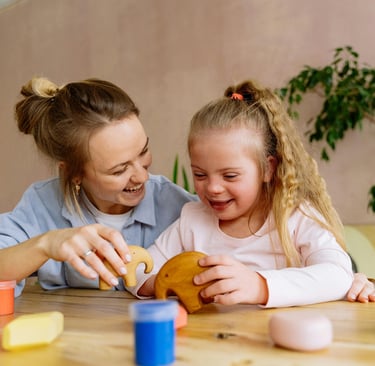
The ratio isn't just an administrative detail. It directly determines how much individual attention your child receives every single day — whether a teacher notices when your child is struggling with a task, ready for a new challenge, or simply having a hard morning. A school can have beautiful infrastructure and a well-designed curriculum, but if one teacher is managing twenty-five children, genuine individual attention becomes mathematically difficult, no matter how skilled or caring that teacher is. This guide explains why this number matters so much, what to ask when you're evaluating schools, and how it plays out in a real Montessori classroom.
How Srushti Montessori Supports Individual Attention
At Srushti Montessori in Jayanagar, Bengaluru, we maintain a teacher-to-child ratio of 1:10 — a deliberate choice, not a cost-driven afterthought. In a Montessori environment especially, where children work independently and at their own pace, a teacher's role is to observe closely and step in with the right guidance at the right moment. That kind of responsive teaching simply isn't possible at scale. Families searching for an individual attention preschool in Jayanagar consistently tell us this ratio is one of the deciding factors in their choice, because it's a number they can verify — unlike vaguer promises of "personalised learning."
What Does Teacher-to-Child Ratio Actually Mean?
Teacher-to-child ratio refers to the number of children a single teacher is responsible for at any given time. It's usually expressed as a number like 1:10 or 1:15 — the first number is teachers, the second is children.
A lower second number is better. 1:10 means far more individual contact time per child than 1:25.
Ratio isn't the same as class size. A class of 30 children with three teachers still has a 1:10 ratio — what matters is the ratio itself, not the room size.
Regulations set a ceiling, not a benchmark. Many preschools operate at the maximum ratio permitted rather than the ratio that's actually best for learning.
Ask for the real, current number — not an aspirational one from the school's marketing material. Ratios can shift during peak enrollment periods if a school isn't disciplined about capping admissions.
Why This Number Matters So Much for Young Children
The early years are when children are least equipped to advocate for themselves — a two- or three-year-old often can't articulate that they're confused, overwhelmed, or ready to move ahead. This is precisely why the adult-to-child ratio matters more here than at any later stage of education.
What a lower ratio makes possible:
Teachers notice small, early signs of a child needing support — before they become bigger struggles
Children get timely feedback and guidance rather than waiting their turn in a queue of classmates
Quieter or slower-to-warm-up children aren't overlooked in favour of louder, more demanding ones
Genuine relationships form between teacher and child, which builds the trust young children need to separate from parents comfortably
Safety and supervision are meaningfully stronger, particularly for toddlers who are still developing risk awareness
Common Parent Concerns — Addressed
"Isn't a low ratio just about safety, not learning?" Safety is part of it, but the bigger impact is on learning quality. In a Montessori classroom, teachers move around observing children working independently, deciding when to introduce a new material or offer help. With too many children per teacher, this individualised guidance becomes reactive instead of proactive — teachers can only respond to whoever asks first, rather than noticing every child who actually needs support.
"How do I verify a school's actual ratio, not just their marketing claim?" Ask directly, and ask again during a school visit — watch how many children are in the room compared to how many staff are actively engaged with them (not just present). A confident school will state its ratio plainly and explain how it's maintained even during high-enrollment periods.
"Does a low ratio mean higher fees?" Often, yes, to some extent — more staff per child does affect operating costs. But it's worth thinking of this as a direct investment in your child's daily experience rather than a discretionary add-on, since it affects nearly every interaction your child has during the school day.
"My child is fairly independent already — does ratio still matter?" Yes. Even confident, independent children benefit from a teacher who has the bandwidth to notice when they're ready for a new challenge, not just when they're struggling. A low ratio supports growth in both directions, not only intervention when something goes wrong.
How Ratio Plays Out at Each Stage
Early Learners (2–3 Years)
Close supervision during toilet training, feeding, and settling-in
One-on-one language interaction throughout the day
Immediate comfort and reassurance during separation anxiety
Mont 2 & 3 (3–5 Years)
Timely introduction of new literacy and numeracy materials based on individual readiness
Teachers able to notice and nurture emerging interests and strengths
Consistent redirection and support for children still building focus and concentration
Mont 4 & Elementary (5–12 Years)
Individualised feedback on collaborative projects
Teachers able to mentor emerging leadership qualities in specific children
Support tailored to each child's pace in critical thinking and responsibility-building
Our goal is not to create identical learners — it is to help every child become the very best version of themselves, and a low teacher-to-child ratio is one of the clearest ways we make that possible in practice, not just in principle.
Why Families in Jayanagar Choose Srushti Montessori
Parents searching for a Montessori preschool in Jayanagar with genuine individual attention often find that ratio is the single clearest, most verifiable signal of a school's real priorities. Families across South Bangalore and Bengaluru choose Srushti Montessori because our 1:10 ratio isn't a number we quote once and forget — it shapes how our classrooms are staffed and run every day, and it's something we're glad to discuss openly with any parent who asks.
Frequently Asked Questions
What is Srushti Montessori's teacher-to-child ratio? We maintain a ratio of 1:10, meaning each teacher is closely engaged with a small, manageable group of children rather than managing a large classroom alone.
Why is a 1:10 ratio considered strong for a preschool? Many preschools in Bangalore operate at ratios closer to 1:15 or 1:20. A 1:10 ratio allows significantly more individual observation, guidance, and responsiveness per child throughout the day.
Does a lower ratio matter more for toddlers than older children? It matters at every stage, but especially for toddlers, who rely entirely on teachers to notice non-verbal cues around comfort, readiness, and distress, since they often can't yet express these clearly in words.
How can I confirm a school's real ratio before enrolling? Ask directly and observe during a visit — count the number of children in a classroom against the number of teachers actively engaged with them, rather than relying on marketing claims alone.
Helping Every Child Thrive
A low teacher-to-child ratio isn't a statistic for a brochure — it's what makes individual attention possible on an ordinary Tuesday morning, not just in theory. At Srushti Montessori, we've built our classrooms around this principle because we believe every child deserves to be genuinely known, not just supervised. Through a low 1:10 ratio, Montessori principles, and experiential learning, we help each child build the confidence, curiosity, and resilience they need to thrive.
If you're comparing preschools in Jayanagar and want to see what real individual attention looks like in practice, we'd love to welcome you for a visit.
Explore More
Related Blog: How to Choose the Right Montessori Preschool in Jayanagar
Related Blog: What Makes a Preschool Truly Inclusive?